
Last updated November 18, 2026
 Architectural shingles
 Metal roofing
 Tile roofing
 GAF
 Owens Corning
 Flat & low-slope
Free roof inspection with deck photos before we talk money - GAF and Owens Corning certified installation
Roof Repair Maintenance Schedule: What to Do and When
If your roof maintenance reminder is set for “spring and fall,” you’re already six weeks behind in Sunrise Manor. The monsoon season starts in mid-June, and anything you meant to seal or clear needs to be done by Memorial Day. In our experience, that gap is where most preventable roof failures begin: a hairline crack in a flat-roof membrane that never got sealed in May becomes a soaked ceiling by the third week of July, and a debris-packed scupper that could have been cleared with a hand rake turns into standing water over an HVAC unit that was never meant to sit in a puddle. Calendar-based maintenance schedules don’t fail because homeowners are careless. They fail because they aren’t built around the desert valley’s actual damage cycles, and Sunrise Manor has two of them, not four.
This guide lays out a maintenance schedule shaped around the two damage seasons and two equipment cycles that actually drive roof problems here. You’ll learn what to inspect and when, which maintenance tasks genuinely extend roof life by years versus which are mostly cosmetic, and how to document the work so a warranty or insurance claim has a defensible paper trail. It’s written for homeowners who plan to stay put, not flip the house.
Quick Answer
The right roof maintenance schedule in a desert valley isn’t tied to the four seasons. It’s tied to two damage seasons and two equipment cycles. Do your deep inspection and pre-monsoon sealing in the first half of May, before the afternoon storms start in mid-June. Then do a post-monsoon assessment in October, once the storms have passed and before the winter dry season. The best free roof inspection you’ll get all year lands on the days your HVAC technician arrives for spring startup and fall shutdown, because they’re already on the roof reading the same equipment that sits on top of it.
Styles & brands we work with
- Architectural shingles
- Metal roofing
- Tile roofing
- GAF
- Owens Corning
- Flat & low-slope
Table of Contents
- Why a Calendar Schedule Fails in Sunrise Manor
- The Pre-Monsoon Calendar: What to Do by Memorial Day
- The Post-Monsoon Assessment: October’s Job
- Your HVAC Visit Is a Free Roof Inspection
- Gutter and Scupper Schedules for Flat-Roof Homes in 89110 and 89115
- Which Maintenance Tasks Actually Extend Roof Life
- How to Document Maintenance for Claims and Warranties
- Common Mistakes to Avoid
- When to Call a Professional
Why a Calendar Schedule Fails in Sunrise Manor
The “inspect in spring and fall” advice is copied from climates with four distinct seasons and freeze-thaw cycles. Sunrise Manor doesn’t have those. It has a long dry stretch, a violent summer storm window from mid-June through September, and a mild winter. The damage cycles that matter here are the ones that ride on that pattern. Hail, wind-driven rain, and debris loading hit hard and fast in the monsoon window. Intense summer UV bakes and shrinks sealant and membrane long before a cold-climate schedule would ever flag it. Meanwhile, fall and spring are the quiet stretches when the small stuff can be caught and cheaply fixed if you actually look.
We’ve also watched the newer tract homes across Sunrise Manor age in a particular way. Many were built in waves over the last few decades, which means whole blocks reach the same failure milestones together. When the sun has cooked the pipe boots and ridge seals on your street, it’s done the same to every house near you. That’s a useful signal: if a neighbor’s roof is leaking, yours is on borrowed time. A maintenance schedule that ignores these local rhythms and instead runs on a generic spring/fall calendar will always be reacting instead of preventing.
That’s why we build the schedule around two dates: Memorial Day, which is your pre-monsoon deadline, and October, which is your post-monsoon assessment. Those two anchors cover the damage seasons. The equipment cycles cover the rest.
The Pre-Monsoon Calendar: What to Do by Memorial Day
May is the one month in Sunrise Manor where a few hours of roof work buys you an entire storm season of protection. The goal is simple: nothing leaks, nothing clogs, and nothing is loose enough for a 50-mph gust to rip up. If you do nothing else all year, do this. Here’s the sequence, in the order that matters most.
- Get a roof inspection in early to mid May, before the first storm. Book it before Memorial Day, not after the first leak. A proper inspection documents what’s there with photos and gives you a baseline for the season.
- Clear every gutter, scupper, and roof drain. Monsoon rain comes in sheets, and debris from winter and spring is still sitting in the channels. Full gutters send water back under the roof edge.
- Check and re-seal the flashings. Pipe boots, step flashings, and valley seams are where water finds its way in first. UV hardens the sealant; the monsoon removes it.
- Remove debris from the roof surface. Palm fronds, twigs, and leaf litter around HVAC units and flat-roof drains trap water and breed the leaks you’ll find in August.
- Look at the flat-roof membrane seams around roof-mounted equipment. This includes the HVAC curb. Standing water and a worn seam are a combination that fails on the first real storm.
- Photograph everything you find, before and after any repair. That file is your paper trail for the season.
If your roof is older or you’ve had a leak in the last two summers, this pre-monsoon inspection is where a professional second opinion is worth having. A trained eye catches a soft flashings and aged boots you might walk right past. For more on what gets repaired and how it’s scoped, see our Roof Repair in Sunrise Manor page. If the inspection turns up more than a patch will fix, that’s a different conversation, and one we’re happy to have with you honestly.
The Post-Monsoon Assessment: October’s Job
October is the mirror image of May. The storms are over, but the damage they delivered is still sitting on your roof, and anything you postpone now has a winter to quietly get worse before the next monsoon arrives. This assessment is about finding what the season did, not preventing the next season. The difference matters: you’re documenting and fixing, not prophylactically sealing.
- Walk the roof perimeter and inspect it with the eye of a claim adjuster. Look for lifted or missing shingles, granule loss in streaks below downspouts, dents from hail, and cracked membrane. Photograph each finding with something for scale.
- Check the flashing and boot seals again. Even a good May sealing job takes a beating through the storm window. October is when you confirm the monsoon didn’t quietly undo it.
- Clear gutters and scuppers a second time. Storm debris loads channels with gravel, granules, and plant matter. Clearing now prevents winter ponding.
- Check around skylights, vent stacks, and any roof penetration. These are the places wind-driven rain exploits, and the leak often doesn’t show up indoors until December.
- Note the HVAC equipment conditions. Confirm the unit, its curb, and its drain plumbing are sound before the furnace season begins.
If October’s assessment turns up damage you didn’t cause and can’t see from the ground, a professional assessment gives you the photos and a written report you need to support a claim. Our team at Ridgeline Roofing Co. has walked enough post-monsoon roofs to tell the difference between normal wear and storm-caused damage. If the roof is past patching, see Roof Replacement & Installation in Sunrise Manor for how a replacement is scoped and scheduled.
Your HVAC Visit Is a Free Roof Inspection
The single most underused maintenance opportunity in Sunrise Manor is the appointment with your HVAC technician. Twice a year, spring startup and fall shutdown, someone who knows rooftop equipment is already standing on your roof. They’re not a roofer, but they’re in the exact spot where most flat-roof leaks begin: the equipment curb, the penetrations, the drain pans, and the platform where water tends to collect.
Ask them to look at a few specific things while they’re up there. This costs nothing and catches real problems early.
- The roof surface around the HVAC unit and its curb. Water stains, ponding, or a worn seal at the base of the unit.
- The condition of the condensate drain line and pan. A blocked or degraded line can mean water is draining onto the roof or into the structure.
- Any obvious tears, blisters, or soft spots in the membrane near the equipment and along the seams between panels.
- Whether debris or vegetation has accumulated against the unit or in the nearby drains.
- The fasteners and flashing around any added vents or access points. Anything that was cut or added on the roof is a bad day waiting.
If they flag something, that’s your cue to get it looked at by a roofer before the monsoon or before winter. We’ve seen a $65 roofer visit catch a failing HVAC curb seal that would have cost thousands to repair after a July storm. If you want a trained eye on that same roof, we’re glad to do it. See Specialty Roofing in Sunrise Manor for the flat-roof and low-slope work these homes need.
Gutter and Scupper Schedules for Flat-Roof Homes in 89110 and 89115
The flat-roof tract homes common in the 89110 and 89115 zip codes present a particular maintenance challenge: they don’t shed water the way pitched roofs do. Instead, they drain through scuppers, internal drains, and downspouts, and if any of those back up, water simply sits on the roof. On a flat roof, standing water is the main enemy. It finds every seam and every fastener and works its way in.
Your gutter and scupper schedule should follow the same two-season rhythm as the rest of the roof.
- Mid-May (pre-monsoon): a full clearing of all gutters, scuppers, and drains. This is the critical clear. Remove all debris so the storm season starts with empty channels.
- October (post-monsoon): a second clearing after the storms, when granules, gravel, and windblown debris have loaded the channels. This clearing prevents winter ponding and keeps the drains ready for the next cycle.
- An extra quick check after any major storm: if you can safely see your gutters and scuppers from the ground, a visual check after a big storm tells you whether a clearing is needed sooner.
Don’t let anyone convince you that gutters and scuppers are secondary on a flat roof. In our experience, roof leaks on these homes start in the drainage system, not the membrane. Clearing them on schedule extends the life of the whole roof by years. Every pre-monsoon inspection we do includes a clear look at how these channels are draining, and we document with photos what we find. For broader flat-roof service guidance, Ridgeline Roofing Co. Sunrise Manor home covers the full range of what those roofs need over time.
Which Maintenance Tasks Actually Extend Roof Life
Not every task that shows up on a maintenance checklist is worth your money. Some are genuinely preventive and can add years to a roof. Others are cosmetic, or just an upsell, or something you can do yourself with a hand rake and gloves. Here’s the honest split, based on what we’ve seen on roofs across Sunrise Manor.
Tasks that genuinely extend roof life by years
- Pre-monsoon sealing of flashings and boots. A small sealant job before June prevents the interior repairs that a single storm would cause. Cheap now, expensive later.
- Regular gutter and scupper clearing. Keeping drainage clear is the single highest-return maintenance item on a flat roof. Standing water is the cause of most of the damage we see.
- Prompt repair of a discovered leak or failing seam. A bad boot replaced for a modest amount today prevents water intrusion and interior damage tomorrow.
- Prompt repair of shingles or membrane section after a storm. A small wind-lifted section is a cheap repair; the same section after a year of water is a replacement.
- Keeping debris off the roof and away from equipment. Debris holds moisture and accelerates wear around every point of contact. A rake and a few minutes twice a year is genuine life extension.
Tasks that are mostly cosmetic or optional
- Pressure washing or cosmetic cleaning of the surface. It improves the look of a roof. It doesn’t meaningfully change how long the roof lasts, and done wrong it can damage surfaces.
- Sealing the entire roof with a generic coating as a routine item. Proper coatings have a place on certain flat roofs, but applying one indiscriminately is not an automatic life extender. It needs to match the roof and be installed properly.
- Paying a yearly “tune-up” subscription that mostly inspects without actually clearing and sealing. Look at what’s actually done, not what’s on the brochure.
Spending on the first list, and skipping most of the second, is the maintenance strategy that makes financial sense. When materials come into it, we install GAF and Atlas products, so we can match proper roof-system materials to the job without substitutions. The question to ask any contractor is simple: is this task fixing or preventing a real problem, or is it a sale?
How to Document Maintenance for Claims and Warranties
A maintenance file is the difference between a claim that gets approval and one that gets denied. If your roof fails after a storm or a warranty issue comes up, having a dated, photographed record of the maintenance you did and when you did it is a defensible paper trail. Insurers and warranty providers ask for proof, and a folder of dated photos answers that better than a verbal memory. Here’s how we recommend keeping it.
- Keep one folder for the roof, physical and digital. Printed receipts, warranty paperwork, and a phone folder of photos, all in one place.
- Daten and caption every photo. Note the month, the area of the roof, and what you’re looking at. “May 10, 2026, north slope flashing, resealed” is worth far more than a pile of unlabeled images.
- Capture before-and-after shots of every repair. The before shot shows the problem, the after shows the fix. Claim adjusters respond to both.
- Photograph any storm damage when you discover it. Date context matters, so the sooner you capture it, the better.
- Keep the contractor’s written report and photos. A professional inspection comes with its own dated documentation. Ask for a copy and keep it in the file.
- Note any equipment work that touched the roof. A line in the file about the HVAC visits puts rooftop work in context if a claim ever asks what happened on that roof.
The best time to start documenting is before you have a problem. A real professional will hand you a photo-documented inspection and a written record you can keep. That’s a core reason we photograph every inspection and send the record to the homeowner. For what a professional inspection covers, the team at Ridgeline Roofing Co. can walk you through it on the phone.
Common Mistakes to Avoid
- Running a “spring and fall” schedule copied from cold climates. In Sunrise Manor it leaves the pre-monsoon seal unfinished while the calendar says there’s more time. Two seasons, two dates, or you’re reacting all summer.
- Waiting until the first leak to look at the roof. The leak in August was caused by something in May. Maintenance is cheap early and expensive late.
- Ignoring the gutters and scuppers because “it’s a flat roof, nobody has gutters.” Flat-roof homes in 89110 and 89115 drain through scuppers and internal drains. Letting them clog leaves water standing on the membrane, which is the worst thing for that roof.
- Wasting the HVAC technician’s visit. You paid for someone to be on your roof twice a year. Asking them to look around the curb and drains while they’re up there costs nothing and catches real problems early.
- Climbing a steep or high roof to “check it yourself.” Height and steep-slope work are genuinely dangerous. A trained professional with the right equipment does the inspection; a homeowner on a steep roof is how a small problem becomes a hospital visit.
- Hiring a storm-chaser after a windstorm without any record of who’s local. A truck that shows up after the storm and is gone by spring has no obligation beyond a handshake. There’s a reason we keep a written workmanship promise and a local presence you can call back for years.
- Skipping the photos. A repair with no dated picture is a repair you’ll be re-explaining to an adjuster in a year.
When to Call a Professional
Some maintenance you can do yourself: raking debris off the gutters, keeping an eye on things, noting problems you see from the ground. Other things call for a trained professional. If you see a soft spot in the roof deck, a stained or sagging ceiling inside, a blister or crack in the membrane, water ponding on a flat roof, or any damage you found after a storm, have it looked at before the next storm season. If you’ve lost shingles or your HVAC equipment is sitting on a suspicious-looking curb, those are likewise worth a look.
Ridgeline Roofing Co. Sunrise Manor offers free estimates in Sunrise Manor, and our phones are answered by a live person around the clock. Call (844) 941-3509 to schedule your free estimate. We’ll document what we find with photos, give you a written, upfront number, and stand behind it with our 90-Day Done Right Promise.
See the difference
 Before
 After
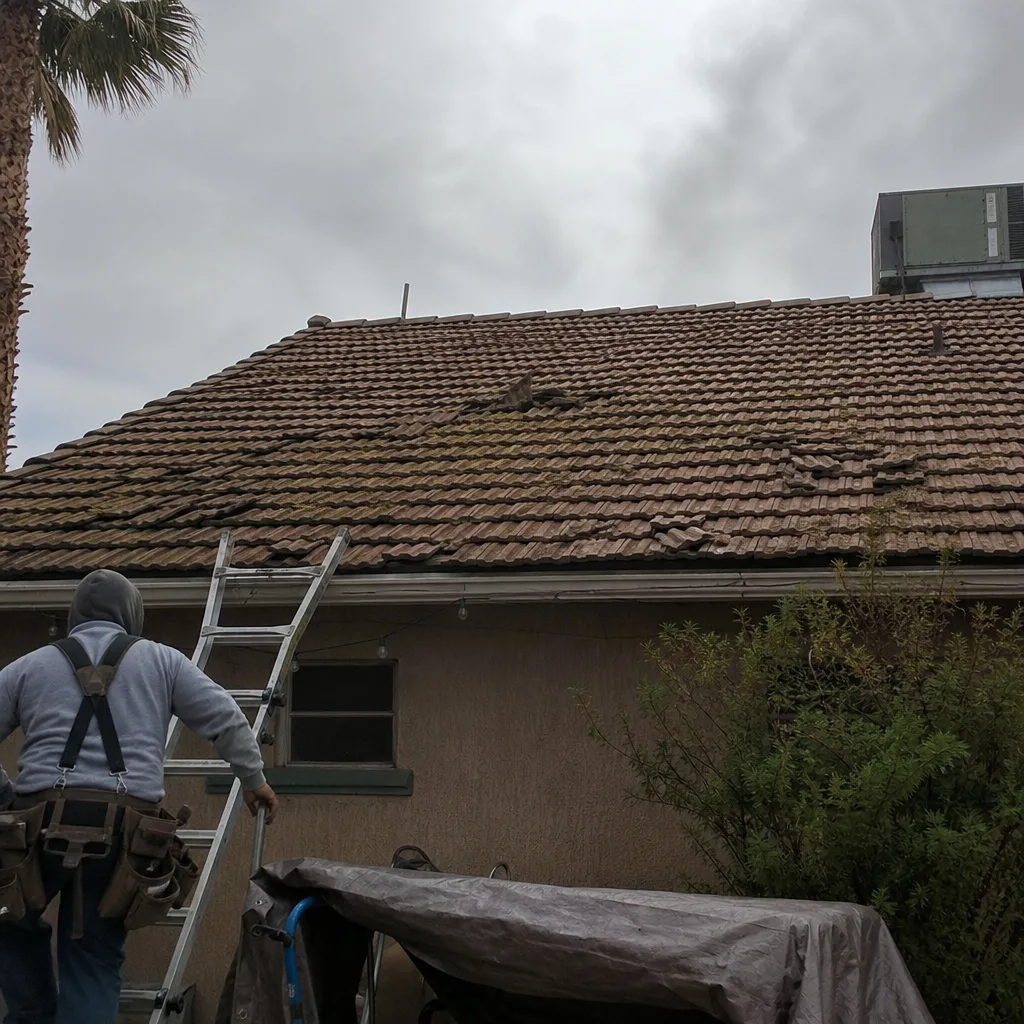 Before
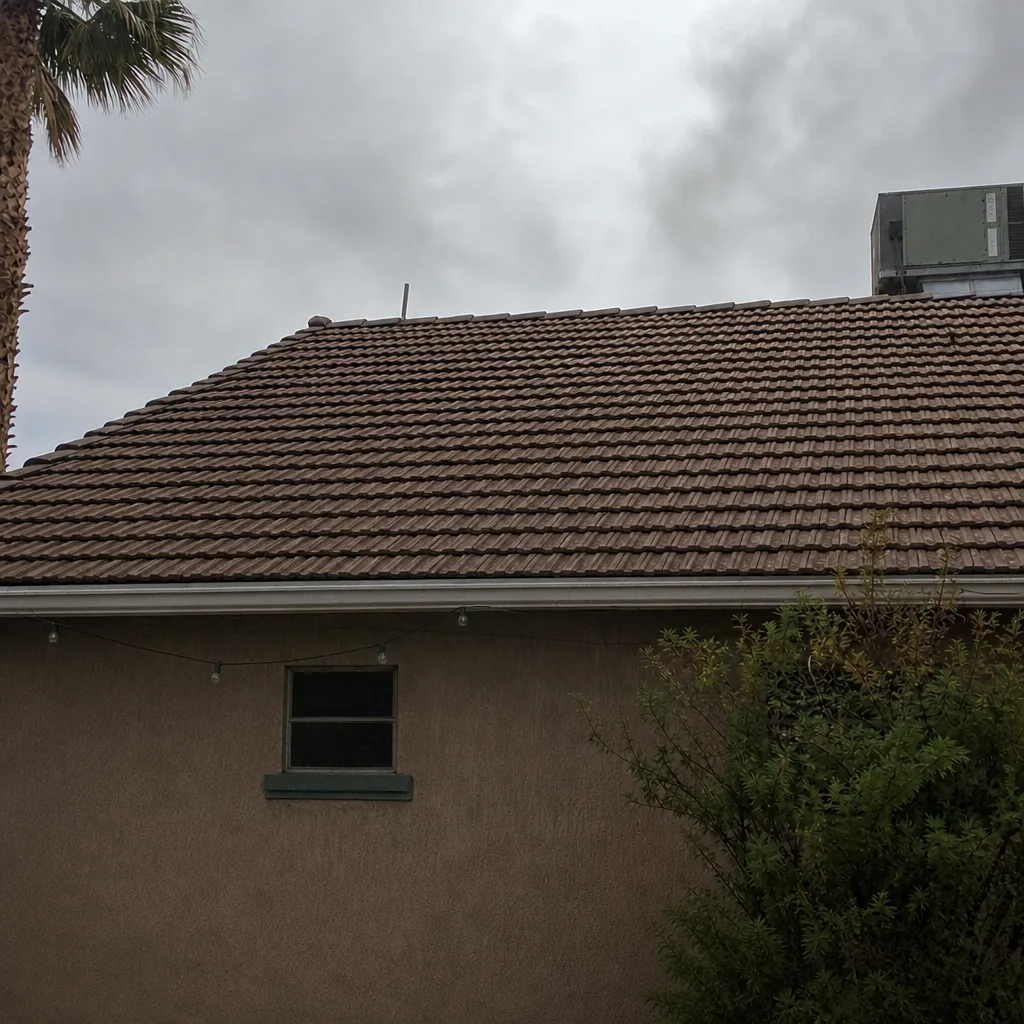 After
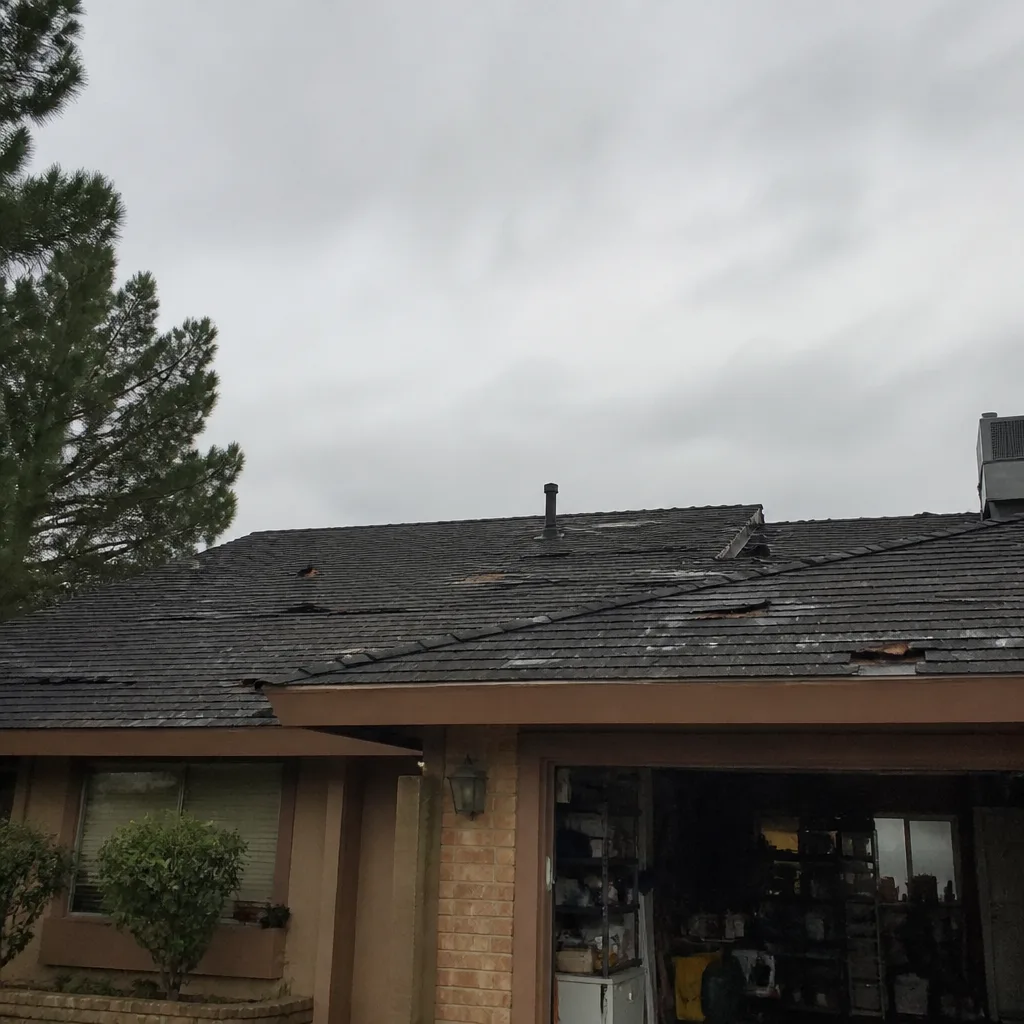 Before
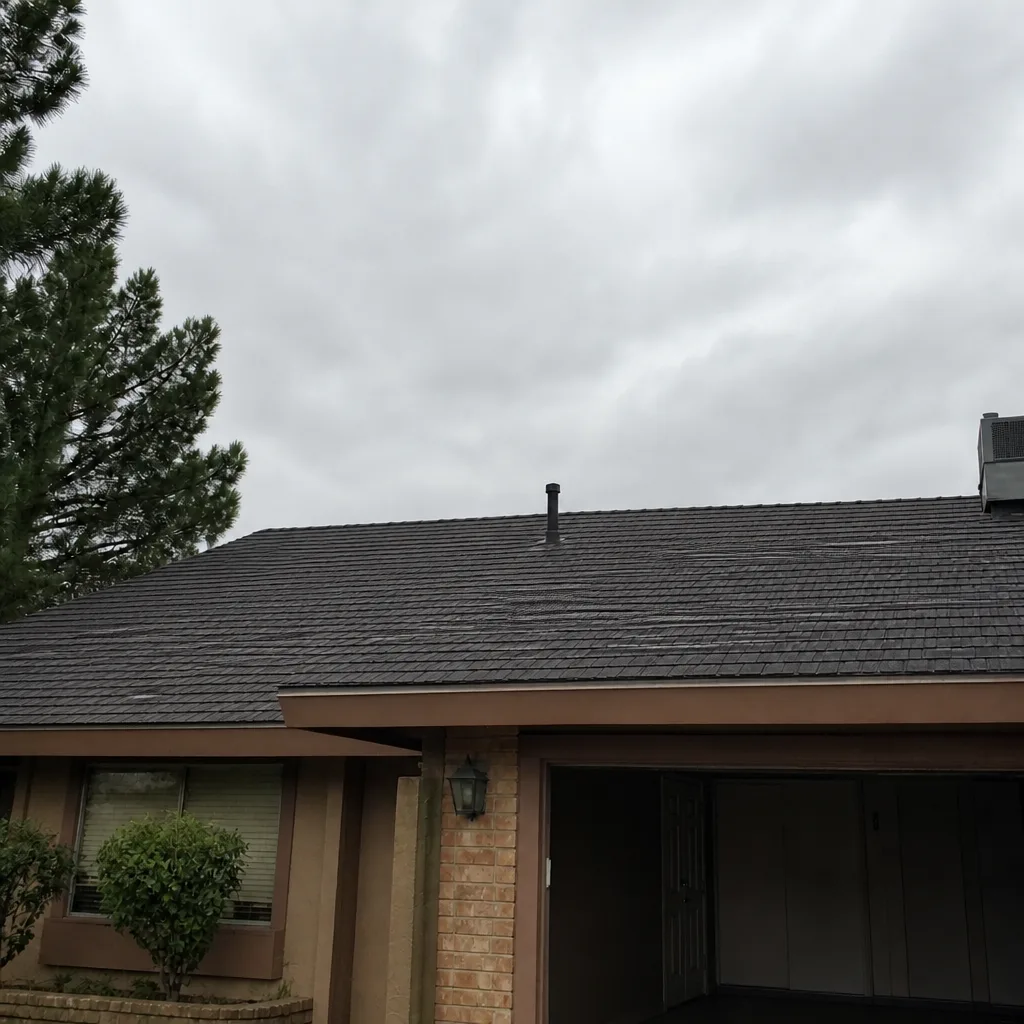 After
Frequently Asked Questions
Twice a year, in May before the monsoon and in October after it. Those two checks cover both damage seasons, and a professional inspection each spring is the best insurance against a summer leak.
Book it by early to mid May, well before Memorial Day. The monsoon season starts in mid-June, and any sealing or clearing needs to be done before the first storms arrive.
They can look for obvious problems, and that’s a genuinely useful free opportunity. They’re on the roof at spring startup and fall shutdown, so ask them to check the area around the unit and its curb, the drains, and any visible cracks or tears. They’re not a roofer, but their observations often catch leaks before you find them.
A basic seasonal tune-up typically runs in the range of an $89 seasonal tune-up offer, and we keep our maintenance pricing simple and upfront. Repair costs depend on what’s found; call (844) 941-3509 for a free estimate on any repair, and we’ll give you a written, no-surprises number.
Yes, on a flat-roof home the drainage system is the maintenance issue that matters most. Once before the monsoon and once after prevents the standing water that causes most flat-roof leaks.
Yes. Dated photos and records of maintenance and repairs give you a defensible paper trail if a claim asks how the roof was maintained. Start the folder before you need it.
The Bottom Line
In Sunrise Manor, a roof maintenance schedule built around the calendar of a cold climate will always be behind. The schedule that works is two-pronged: a pre-monsoon prep in May that seals, clears, and documents, and a post-monsoon assessment in October that finds and fixes what the storms left behind. The HVAC technician’s spring startup and fall shutdown are your free roof inspection opportunities, and the flat-roof homes in 89110 and 89115 live or die on their scuppers and drains. Do the tasks that actually extend roof life. Skip the cosmetics. Keep the photos. A little seasonal work, done right, is how a roof stays sound for decades instead of seasons.
Our team at Ridgeline Roofing Co. is here when you need the professional eye. We’ll document, quote upfront, and make it right. Call (844) 941-3509 to schedule your free estimate.
Written by the team at Ridgeline Roofing Co. Sunrise Manor.