
Last updated November 18, 2026
 Architectural shingles
 Metal roofing
 Tile roofing
 GAF
 Owens Corning
 Flat & low-slope
Free roof inspection with deck photos before we talk money - GAF and Owens Corning certified installation
Gutters & Accessories Warning Signs Every Homeowner Should Know
Most gutter problems are found in the rain, and that is the worst possible time to find them. By the time you see water sheeting over the fascia, it has already been soaking the wood behind it for a season or more. The warning signs that actually matter show up on a dry Tuesday afternoon in Sunrise Manor, when the sky is clear and the sun is throwing hard shadows across stucco. A paint streak here, a white crust line there, a dip in the run you have walked past a hundred times. This guide covers the dry-day cues, the seam and hanger failures that precede a full pull-away, and the desert-specific problems sandy soils and caliche create for Sunrise Manor gutters.
Quick Answer
The most reliable gutter warning signs are paint streaks or bubbling on the fascia board, white mineral deposits on the stucco below the roofline, separated or gapped seams, a rhythmic sag between hangers, hardened sediment inside the channel, and erosion craters under downspouts. In Sunrise Manor, the desert climate adds two more: sediment that never washes out on its own, and downspout erosion craters caused by sandy soil that can’t absorb concentrated runoff. Catching these on a dry day gives you weeks or months of lead time before the wood rot and foundation staining begin.
Styles & brands we work with
- Architectural shingles
- Metal roofing
- Tile roofing
- GAF
- Owens Corning
- Flat & low-slope
Table of Contents
- Dry-Day Visual Cues: What to Look For on a Clear Afternoon
- Separated Seams: Cosmetic Gap or Structural Failure?
- Hanger Spacing Failure and the Sag Pattern That Precedes a Pull-Away
- Why Desert Homeowners Should Check Gutter Interiors for Caliche Sediment
- Downspout Problems Specific to Sandy Soils and Desert Foundations
- Ground Erosion Channels Below the Roofline
- A 15-Minute Dry-Day Inspection Walkthrough
- Common Mistakes to Avoid
Dry-Day Visual Cues: What to Look For on a Clear Afternoon
The signs that matter most are already visible before it rains. Spend fifteen minutes walking the perimeter of your house on a dry afternoon and you’ll catch most gutter failures long before they cost you fascia boards or stucco repair. Here is what to look for, in the order we check them.
Paint streaks on the fascia. The fascia is the flat board the gutter is mounted to. When water has been escaping behind the gutter for a season or two, the paint along that board starts to streak, blister, or peel in long vertical lines. The streaking is often the first visible evidence, and it appears six months to a year before the wood shows rot. If you see streaks running down from where the gutter meets the roofline, the gutter is not catching what it should.
White mineral deposits on stucco. Sunrise Manor homes are largely stucco and masonry, and stucco tells on itself. When water runs repeatedly down the same stucco surface, it leaves a chalky white mineral line – the same crust you see on a shower head. Look for horizontal bands of it just below the fascia line, or vertical trails running down toward the foundation. Any white crust line on stucco is water that has been regularly bypassing the gutter.
Sun-bleached or darkened patches. UV in Sunrise Manor is unforgiving. Gutter runs that are holding water (rather than shedding it) show uneven sun bleaching, and wooden fascia behind a leaky gutter darkens before it rots. If one section of fascia looks off-color compared to the adjacent run, that’s a signal.
Mud spatter on the wall. When water splashes out of a clogged gutter at the outside edge, it throws dirt and grit onto the wall just below. Look for a line of mud spots at roughly four to six inches below the gutter line. That’s a gutter that has been overflowing for a while.
In our experience across Sunrise Manor, the paint streak and the stucco mineral line are the two most reliable dry-day signals. Both are cheap to catch early and expensive to ignore. The gutters and accessories work we do on Sunrise Manor homes starts with reading those two signals, because they tell us how long the failure has been running.
Separated Seams: Cosmetic Gap or Structural Failure?
Gutter seams pull apart for two reasons: thermal expansion and physical weight. In Sunrise Manor, both are constantly at work. Summer temperatures swing from the low sixties at dawn to over a hundred by midafternoon, and that daily expansion and contraction cycles the metal enough that a poorly seated seam will open up over a few seasons. Add the weight of trapped sediment and standing water, and the joint gives.
The question is whether a gap is cosmetic or structural. Here is how to tell from the ground.
- Look at the gap width. A hairline gap under a sixteenth of an inch is cosmetic – it can be re-sealed with gutter sealant. Anything wider than an eighth of an inch where you can see daylight or the fascia board behind the joint is structural and needs repair, not just caulk.
- Check the alignment of the two runs. If one section of gutter has dropped or shifted relative to the other, the seam has failed structurally. The two pieces should sit flush and level. A waterfall cascade at the seam when it does rain confirms it.
- Look for staining at the joint. Dark staining on the fascia immediately behind the seam means water has been running behind the joint, not through it. Caulk will not fix that. The seam needs to be re-set.
- Check the end cap. End caps fail the same way seams do. Look at the corners of the gutter run. If the end cap sits proud of the channel or has a visible shadow gap, it is leaking.
The mistake homeowners make is treating a structural seam failure with caulk. Caulk hides the gap for one season, then fails. If you are seeing repeated failures at the same joint every year, the seam has structural movement behind it. This is one of the reasons we recommend a proper Roof Repair in Sunrise Manor inspection when a seam has failed twice – the underlying issue is often a fascia board that has started to bow, which moves the seam with it.
Hanger Spacing Failure and the Sag Pattern That Precedes a Pull-Away
Every gutter is hung on hangers – brackets or spikes – spaced along the fascia. When the spacing was too wide from the start, or when a hanger has pulled loose, the gutter sags. The sag is subtle at first. You can walk past a gutter for two years and not notice that the run has a gentle dip every eight feet. But that dip is the early warning of a full pull-away, and in Sunrise Manor, once a gutter sags, sediment settles in the low spot and the problem accelerates.
How to spot the sag pattern from the ground. Stand at one end of the gutter run and sight along the bottom edge toward the far end. The line should be dead straight (or slightly pitched toward the downspout). A rhythmic dip – up, down, up, down – every six to ten feet tells you the hangers are too widely spaced. A single long dip tells you one hanger has pulled. A sag that extends more than a few feet out from the fascia means the hanger has pulled out of the wood and the gutter is only held by the remaining hangers.
The pull-away sequence. This is what we see most often on twenty-plus-year-old homes in Sunrise Manor:
- Hanger spacing exceeds thirty inches (industry standard is typically twenty-four to thirty inches depending on the gutter profile, and desert heat cycling argues for tighter spacing).
- The gutter sags between hangers under the weight of sediment and standing water.
- Water pools in the sag, weighing the gutter further.
- Fasteners back out of the fascia, or the fascia itself begins to soften.
- The gutter pulls away from the fascia at one end and the whole run begins to hang.
By the time the pull-away is visible from the street, the fascia board has often taken on water. Catching the sag on a dry day is a fascia-board savings. When the sag is paired with visible rot behind the gutter, that’s a broader roof system issue that needs a full look. We discuss how that plays out in our Roof Replacement & Installation in Sunrise Manor guide.
Why Desert Homeowners Should Check Gutter Interiors for Caliche Sediment
This is the section most homeowners outside the desert never see in a gutter guide, and it matters specifically in Sunrise Manor. In wetter climates, the primary gutter problem is leaves. In the desert, the primary problem is mineral sediment. The fine dust that settles on Sunrise Manor roofs is heavy in calcium carbonate, and when it washes into the gutter, the water evaporates and leaves the minerals behind. Over a season, that sediment cures into a hard, concrete-like layer that will not wash out with a rainstorm and will not break up with a garden hose.
We call it caliche sediment because it behaves the same way as the caliche soils under Sunrise Manor foundations – hard, layered, and stubborn. It builds up in the bottom of the gutter channel, usually one to three inches deep in the low spots, and it holds water against the metal even when the gutter is otherwise clean.
How to check for it in Sunrise Manor.
- Look in the low spots. Caliche sediment settles where the water sits, so check each sag point. If you can see a uniform gray or tan deposit instead of shiny metal, that is sediment.
- Look at the downspout outlets. Sediment that has reached the downspout is already causing partial clogs. If the outlet at the bottom of the downspout is dry on a day after rain, the downspout is blocked upstream.
- Tap it. Sediment that has cured responds to a light tap with a dull thud rather than the hollow ring of metal.
Cleaning caliche sediment is not the same as clearing leaves. It needs to be broken up with a scraper or a small trowel – which is why we recommend an annual gutter service for any Sunrise Manor home with mature trees or desert dust exposure. A gutter that is clean on top but holding a hardened sediment layer in the bottom is still a failing gutter.
The sediment layer also weakens the gutter metal itself. Persistent standing water accelerates corrosion at the sediment line. If you want to understand how far gone the metal is, we cover it in our Specialty Roofing in Sunrise Manor guide, which includes the seamless gutter and fascia trim options we install.
Downspout Problems Specific to Sandy Soils and Desert Foundations
A gutter is only as good as what happens at the bottom of the downspout. In Sunrise Manor, sandy soils present a specific problem: they look absorbent, but once the surface crusts, they shed water rather than accept it. The result is that water leaving a downspout hits the ground and runs laterally across the surface instead of infiltrating, and the damage happens at the foundation edge.
The three downspout warning signs we see most often.
Erosion craters. Look at the ground directly beneath the downspout outlet. A crater – a bowl-shaped depression three to six inches deep, sometimes with a splash pattern spreading outward – means the runoff is landing with too much force and too little absorption. In Sunrise Manor’s sandy soils, craters can form within a single monsoon season. Extended downspouts, splash blocks, or buried drain lines fix this before the crater undermines the foundation edge.
Foundation staining. Water that runs along the foundation wall leaves a wicking line of darker soil and a mineral crust at the base of the stem wall. On Sunrise Manor homes with finished stucco, you’ll see the staining line clearly. That line means water has been sitting against the foundation long enough to soak into the wall base. That is the doorway to foundation settlement and interior moisture, and in a home you plan to stay in, it is exactly the sort of problem you want to catch before it becomes a five-figure fix.
Backflow at the elbow. The elbow is the short kick-out at the bottom of the downspout that directs water away from the wall. If the elbow is undersized, clogged, or missing, the water backs up the downspout during heavy rain and forces it to spill out at the seam above. From the ground, this looks like a wet streak running down the wall – but the cause is at the bottom, not the top. Look for splash marks and mud splatter behind the elbow, or a distinctive wet streak running horizontally along the base of the wall.
The desert version of the problem is compounded by the fact that Sunrise Manor gets its rain in concentrated bursts during monsoon season rather than a steady drizzle. A downspout that handled a two-hour rain in a humid climate can be overwhelmed in ten minutes of heavy desert rain. That makes sizing and placement of elbows and extensions more important here than in most parts of the country. When we install gutters on a Sunrise Manor home, we size the downspout count for the pitch of the roof and the soil conditions on the lot, not just the square footage.
Ground Erosion Channels Below the Roofline
Gutter water has to go somewhere, and in Sunrise Manor it usually goes sideways. Look for shallow channels carved into the soil on the lot – typically running from below a downspout toward a low spot, a fence line, or the neighbor’s yard. These channels are the evidence that the gutter system is either under-sized, misdirected, or leaking at a seam above.
What erosion channels look like in sandy desert soil. Unlike clay soils that form visible gullies, sandy soils erode in wide, shallow swaths. The channel might be only three to four inches deep, but it can run fifteen or twenty feet. The giveaway is the sand: the topsoil has been stripped to a lighter, coarser grain, and exposed roots of desert landscaping plants along the channel tell you the water has been moving through that line for more than one season.
What the locations tell you.
- Channel running along the foundation wall. Downspout is discharging too close to the house. Extend the discharge line.
- Channel cutting across the driveway or walkway. Downspout is discharging onto a hard surface that is shedding water sideways. Redirect to a landscaped area or a buried line.
- Channel converging under a downspout cluster. Too many downspouts discharging into one spot, or an elbow has failed. Spread the discharge points.
- Channel starting below a seam, not a downspout. The seam above is leaking, and the water has been running down the wall and cutting a channel at the base. Repair the seam first.
Erosion channels on their own are a nuisance. Erosion channels paired with a foundation staining line are a real problem, and in Sunrise Manor more than one of these has turned into foundation work that dwarfed the cost of the gutter fix that would have prevented it. The guide to our Ridgeline Roofing Co. Sunrise Manor home page covers how a complete roof and gutter assessment fits together.
A 15-Minute Dry-Day Inspection Walkthrough
Here is the routine we walk on every Sunrise Manor inspection. It is fast, it needs only a pair of close-focusing eyes and a phone camera, and it catches the majority of failures before they escalate.
- Start at one corner and walk the perimeter counterclockwise. Bring your phone. Take one photo of each wall’s gutter run, from a step back so you see the fascia and the top of the gutter line in frame. Photos make the subtle stuff obvious when you look at them side by side.
- Look at the fascia for paint streaks and dull patches. Any vertical streak below the roofline is a leak. Any dull patch on an otherwise bright board is water.
- Look at the stucco for white mineral lines. Horizontal bands at the gutter line, or vertical trails running down toward the foundation. Photograph both.
- Sight along each gutter run and note sags. Stand at the corner and sight along the bottom edge toward the next corner. Any dip that breaks the straight line goes in the notes.
- Check each seam for a visible gap. Look at the joint where two run sections meet. A gap wider than an eighth of an inch is structural.
- Look at the ground beneath each downspout. Craters, mud splatter, splash marks, or a visible flow channel away from the outlet. Photograph each.
- Look along the foundation for staining lines. A darker wicking line at the base of the stucco or the stem wall is water running from above.
- Look inside the gutter if you can safely see it from a ladder. We do not recommend climbing onto the roof. If a step ladder gets you a clear look at the gutter channel, check the low spots for hardened sediment. If you are not comfortable on a ladder, that’s fine – a licensed inspection will cover it.
The whole walk should take under twenty minutes. If you are checking a Sunrise Manor home with more than one roofline, add five minutes. The point is not to fix anything on this walk. The point is to see the failure on a dry day, when you have time to make the call on your terms rather than in a downpour.
Safety note. Gutter inspection at the roofline involves ladder work and, at some homes, roof-edge work. We do not recommend homeowners climb onto the roof, particularly on a hot Sunrise Manor afternoon when the roof surface can be too hot to safely touch. Leave ladder and roof-edge access to trained professionals. The ground-level walk catches most of the signs.
Common Mistakes to Avoid
- Waiting for the next rain to check the gutters. By the time water is cascading over the fascia, the wood behind it has already cycled through a wet-dry season. Sunrise Manor’s rain comes in bursts, so the interval between the failure and the visible symptom can be a year. Check on a dry day so you have the lead time.
- Treating every seam gap with caulk. Caulk fixes cosmetic gaps under a sixteenth of an inch. Structural gaps over an eighth of an inch, or any gap where one section has shifted relative to the other, need the seam re-set. Caulking a structural gap is a one-season patch.
- Assuming the gutter is clean because the top looks clear. In Sunrise Manor, caliche sediment in the bottom of the channel can cure hard while the top of the gutter looks spotless. The low spots are where the sediment sits – that’s where to look.
- Ignoring sediment beneath the downspout outlets. A crater under the outlet and a clean gutter above it means the discharge is the problem, not the intake. Extending the downspout or adding a splash block is the fix; cleaning the gutter does not help.
- Patching a hanger that keeps backing out. If the same hanger has pulled loose twice, the fastener is failing because the fascia board behind it is wet or soft. Repair the wood first or the hanger will fail again.
- Letting a sag go because “it hasn’t caused a problem yet.” The sag is the problem. It pools water, accelerates sediment buildup, and shortens the life of the run. Every sag we have ever replaced started as a sag we could have caught on a walk.
- Hiring the lowest bid from a company that isn’t local. After a storm, out-of-town crews come through Sunrise Manor. The gutter work looks fine until the first monsoon, and then the phone number is no longer in service. A local contractor with a written workmanship guarantee is the right comparison point.
See the difference
 Before
 After
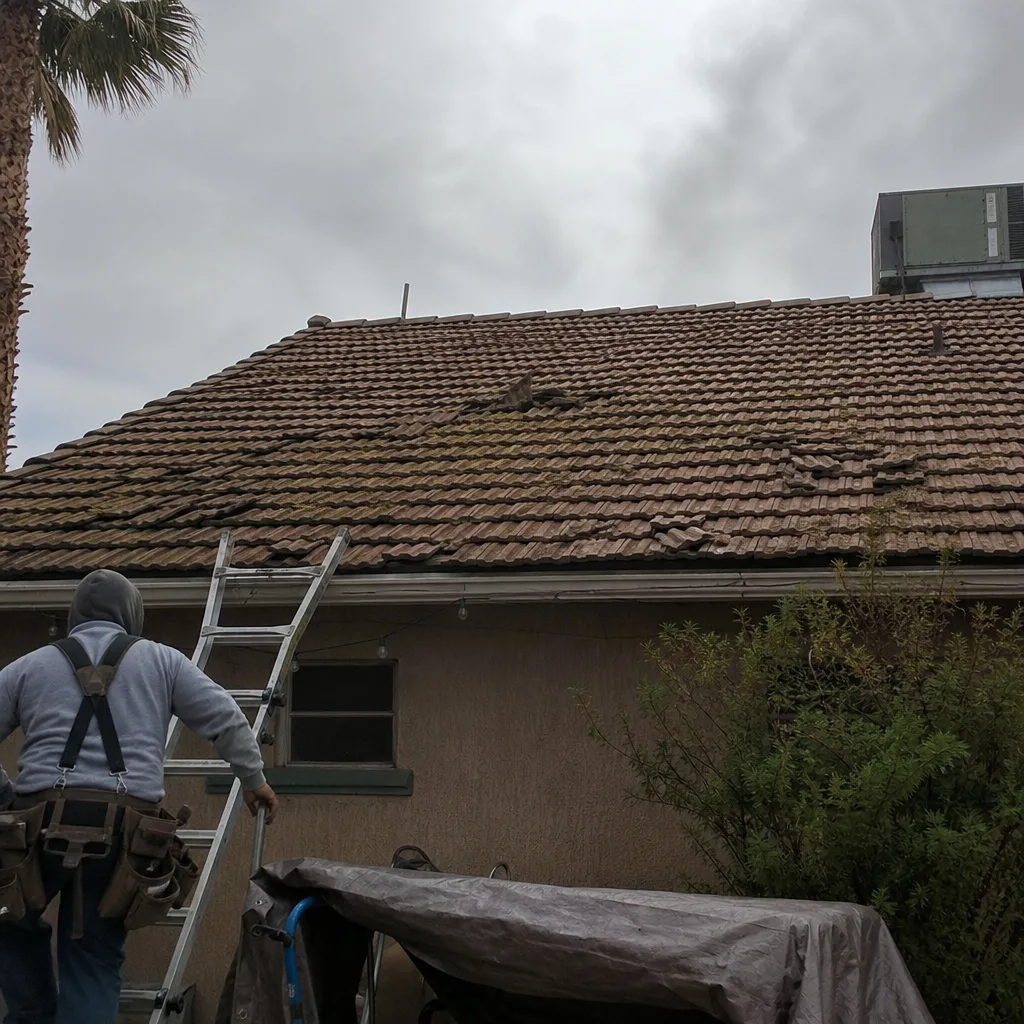 Before
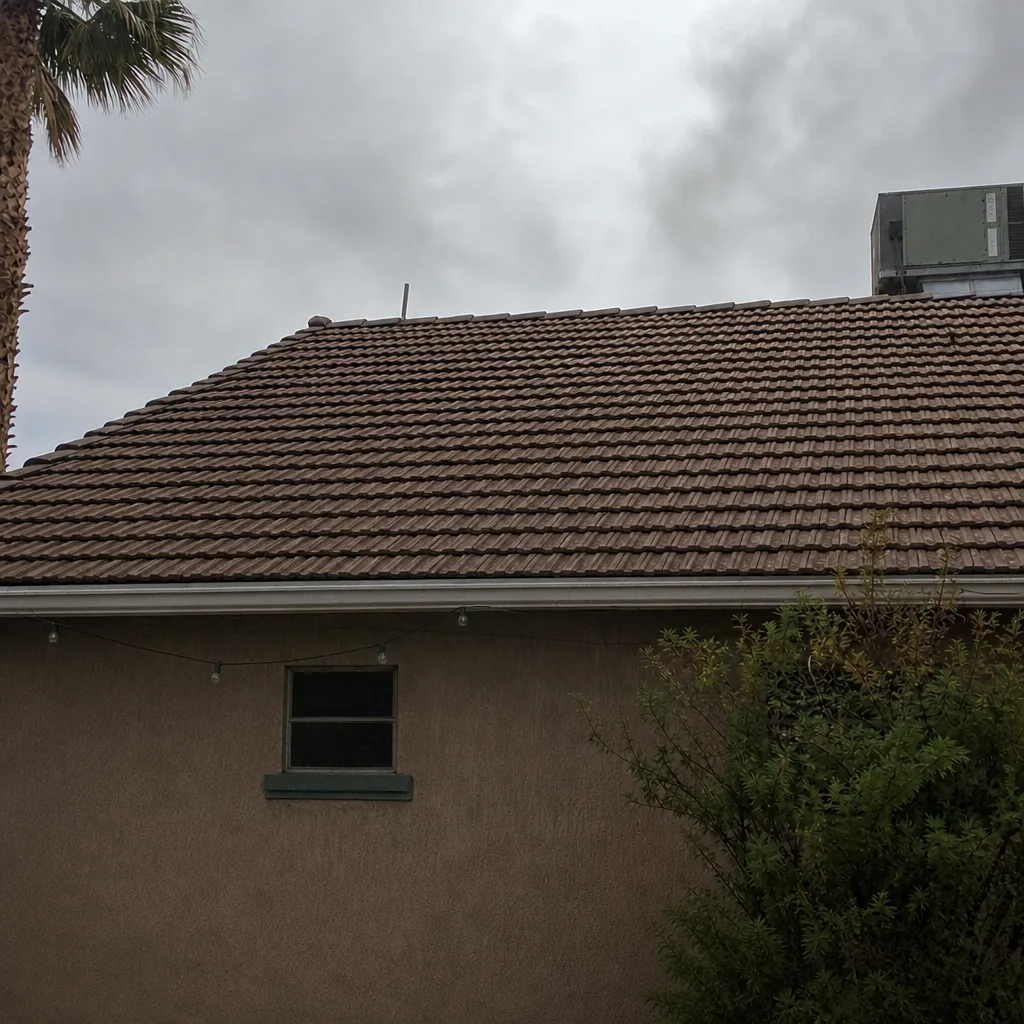 After
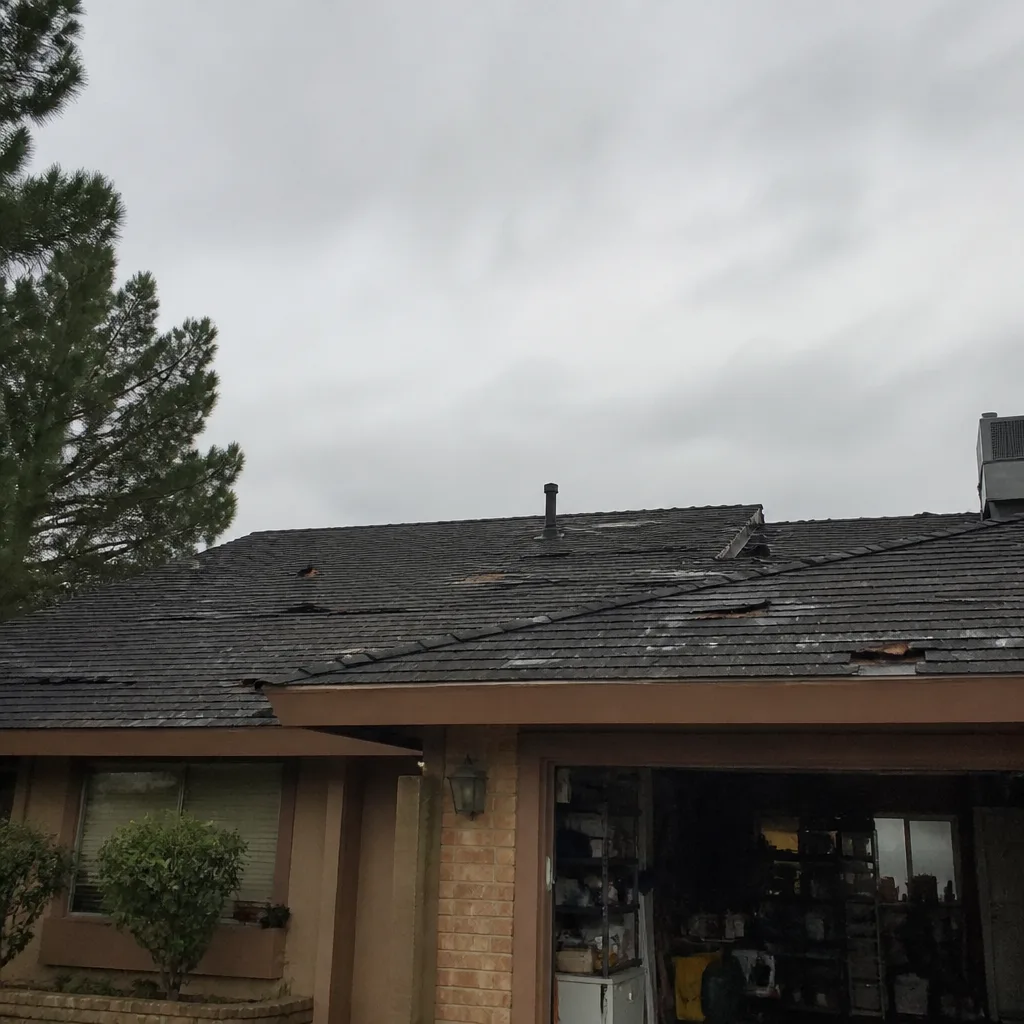 Before
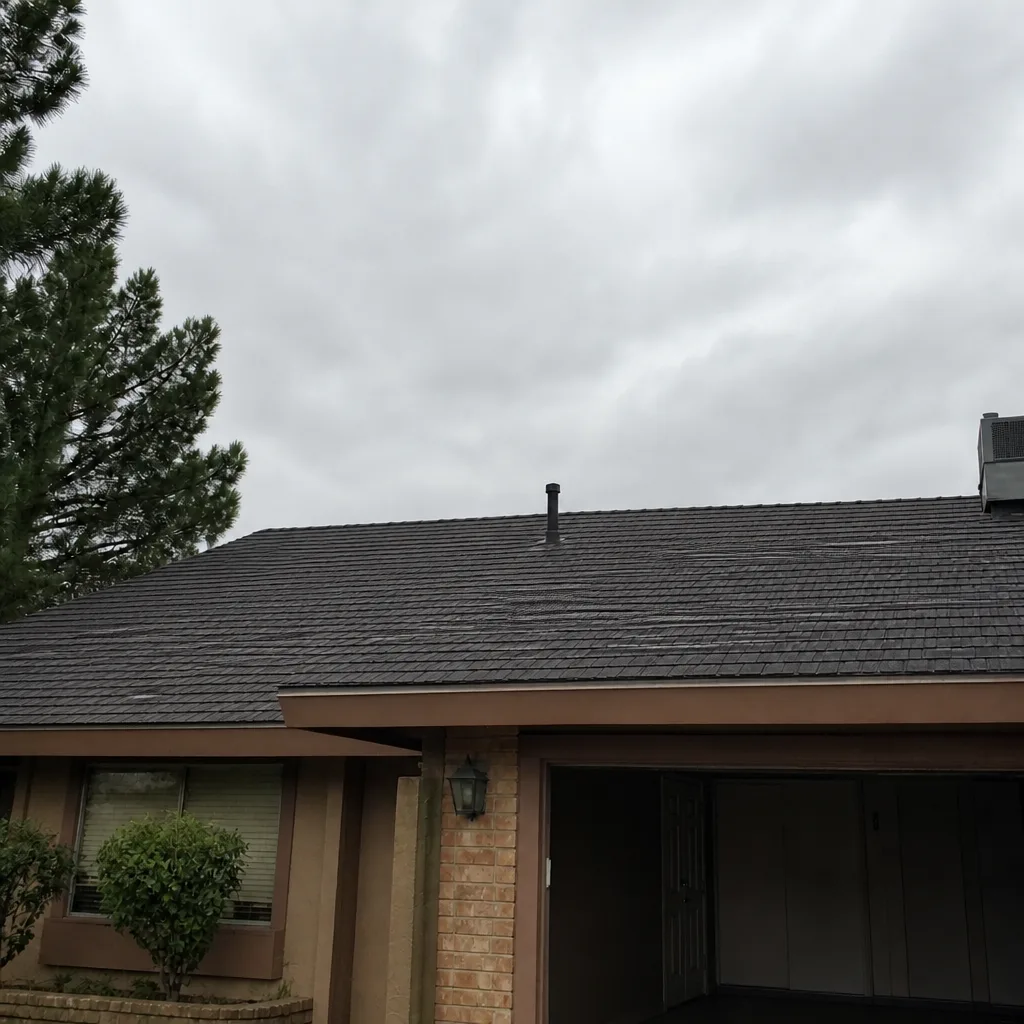 After
When to Call a Professional
Call a professional when the sign you are looking at implicates the roof system, not just the gutter. A paint streak on the fascia that runs behind the gutter, a stucco mineral line at the roofline, a sag that has moved the gutter more than a few inches off the wall, or any gutter pull-away paired with visible rot behind the fascia – these are not gutter-only fixes. They are roof and gutter system issues, and the repair has to address the source or it will re-open within a season. The same applies to a repeated seam failure at the same joint, an erosion channel that runs along the foundation, or any foundation staining line you can trace to a roofline above. Those need a trained eye on the actual roof, not a driveway conversation. Ridgeline Roofing Co. Sunrise Manor offers free estimates in Sunrise Manor – call (844) 941-3509 to schedule one. Our technicians are background-checked, arrive in uniform, and document every inspection with photos taken from your actual roof. If the work is not right, our written 90-Day Done Right Promise says we come back and make it right – no paperwork, no arguing.
Frequently Asked Questions
Look at the fascia board for paint streaks, the stucco for white mineral lines, the gutter run for sags, and the ground beneath each downspout for erosion craters. Any one of these indicates a failure that has been running long enough to leave a mark. Sunrise Manor homes show the stucco mineral line more clearly than most because the wall finish is a masonry surface that holds the deposit. A dry-day walk catches most of these in fifteen minutes. Call (844) 941-3509 for a free estimate if you find any of them.
Caliche sediment – the hardened calcium-rich deposit that forms when desert dust washes into a gutter and the water evaporates – cures to a concrete-like layer in the low spots of the gutter channel. It holds water against the metal, accelerates corrosion, and will not wash out with a rainstorm or a garden hose. Sunrise Manor homes need the sediment broken up and scraped out at least once a year. If the low spots feel like rock instead of metal, that gutter needs service.
Yes, a gap under a sixteenth of an inch where the two sections are still flush and level is cosmetic and can be re-sealed with gutter sealant. A gap over an eighth of an inch, or any gap where one run has shifted relative to the other, is structural. Caulking a structural gap is a one-season fix that fails as soon as the temperature swings. Call (844) 941-3509 for a free estimate if the seam has failed twice.
Sunrise Manor’s sandy soils crust at the surface and shed water rather than absorbing it, so water leaving a downspout runs laterally across the surface instead of soaking in. During monsoon season, the concentrated burst overwhelms even a properly sized downspout, and the lateral flow carves the crater. The fix is an extended downspout, an improved splash block, or a buried drain line to move the discharge away from the foundation edge. Cheap fix now, expensive foundation problem later.
Twice a year at minimum, once after monsoon season and once in the spring, plus one additional dry-day walk after any high-wind event. Sunrise Manor’s dust and caliche sediment mean the interior needs a scrape, not just a rinse, and the two climate seasons here – dry spring and monsoon summer – put different stress on the system. Homes with mature mesquite, palm, or olive nearby need a third check after each seasonal drop. Call (844) 941-3509 to schedule a professional inspection.
Yes. Every job we do is covered by our written 90-Day Done Right Promise – if it is not right, we come back and make it right, with no paperwork and no arguing. The price on the estimate is the price on the invoice, and we install products from seven manufacturer lines including GAF, CertainTeed, and Owens Corning. Call (844) 941-3509 for a free estimate on gutter work in Sunrise Manor.
The Bottom Line
The gutter warning signs that matter in Sunrise Manor are the ones you can see on a dry afternoon: the paint streak on the fascia, the white line on the stucco, the sag between hangers, the caliche sediment in the channel, the crater under the downspout, and the erosion channel running along the foundation edge. Each one is a failure that has been running for months. Catching any of them on a clear day gives you the lead time to fix the problem on your schedule rather than in the middle of a monsoon. Walking the perimeter twice a year and making one call when something looks off is the whole system. That is the difference between a gutter that lasts and a gutter that takes fascia board and foundation with it. Ridgeline Roofing Co. Sunrise Manor offers free estimates and photo-documented inspections for gutter and roof work in Sunrise Manor. Call (844) 941-3509 to schedule yours. Our phones are answered by a live person, day or night.
Written by the team at Ridgeline Roofing Co. Sunrise Manor.