
Last updated November 18, 2026
 Architectural shingles
 Metal roofing
 Tile roofing
 GAF
 Owens Corning
 Flat & low-slope
Free roof inspection with deck photos before we talk money - GAF and Owens Corning certified installation
The Complete Emergency & Storm Damage Guide for Sunrise Manor Homeowners
A monsoon microburst in the Las Vegas valley can drop 60 mph straight-line winds on one block and leave the next block untouched. Which means your neighbor’s roof being fine says nothing about yours. We’ve walked Sunrise Manor neighborhoods the morning after a storm and found shredded shingles on one house and a pristine roof twenty feet away. That’s the strange math of desert weather. This guide covers the three storms that actually damage Sunrise Manor roofs – microburst wind, monsoon flash flooding, and hail – plus the first 24 hours that protect your insurance claim, how to document damage safely, and how clay tile, flat foam, and composition shingle roofs each fail differently. Nothing generic. Just what hits this valley.
Quick Answer
Sunrise Manor storm damage is rarely caused by hurricanes. It comes from short, violent microburst winds, monsoon flash flooding that backs up under tile and behind fascia, and occasional hail that pits shingles and cracks clay. If a storm just hit your house, photograph everything from the ground, call your insurer, and get a documented roof inspection before signing anything. Most Sunrise Manor roof damage we see is repairable if it’s addressed in the first few weeks – and much of it gets quietly worse if it isn’t.
Styles & brands we work with
- Architectural shingles
- Metal roofing
- Tile roofing
- GAF
- Owens Corning
- Flat & low-slope
Table of Contents
- The Three Storms That Damage Sunrise Manor Roofs (and What Each Leaves Behind)
- Your First 24 Hours After a Storm: Steps That Protect the Claim
- How to Document Damage Safely Without Voiding a Repair Warranty
- Clay Tile, Flat Foam, and Composition Shingle: Same Storm, Different Breakage
- How Photo-Documented Inspections Work With an Insurance Claim
- Storm-Chaser Red Flags in the Las Vegas Valley Market
- What Sunrise Manor Homeowners Can Do Before the Next Monsoon
- When It’s Time to Call a Professional
The Three Storms That Damage Sunrise Manor Roofs (and What Each Leaves Behind)
Most storm-damage guides are written for the Midwest or the Gulf Coast. They talk about tornadoes and hurricanes. That’s not what hits Sunrise Manor. We get three specific storm types, and each one scars a roof in its own way. Knowing which one just passed over your house tells you where to look.
1. Microburst Wind
A microburst is a column of air that slams down and fans out in a straight line. On the east side of the valley, they can hit 60 to 70 mph and last only a few minutes. What they leave behind: lifted or creased shingles, missing cap shingles along the ridge, torn drip edge, and loosened tile. The damage is often concentrated along one edge or ridge line facing the wind, which is why a single missing shingle on the windward side is a signal, not a fluke.
2. Monsoon Flash Flood
Desert rain doesn’t soak in – it runs. Sheet flow off the Sheep Range and the surrounding foothills can push water against fascia, into valleys between tile courses, and behind flashing. What it leaves behind: water stains on soffit, saturated underlayment, popped fasteners, and standing water trapped under flat foam roofs. A leak that shows up two days after a storm is almost always flood-driven, not wind-driven.
3. Hail
Hail in the Las Vegas valley is uncommon but not rare. When it comes, it’s usually small – pea to marble size – but driven sideways by wind. What it leaves behind: bruised asphalt shingles (soft spots you can feel but not always see), cracked or chipped clay tile, and pitted metal flashing and vents. Hail damage is easy to miss from the ground and easy to undercount on an insurance claim if nobody documents it properly.
If more than one of these hit at once – which happens in a strong monsoon cell – the damage compounds. Wind lifts a shingle, floodwater gets under it, hail bruises the surrounding field. If you’re not sure which storm did what, that’s exactly the kind of question a photographed roof inspection is designed to answer. For a full picture of standard repairs, see our Roof Repair in Sunrise Manor page.
Your First 24 Hours After a Storm: Steps That Protect the Claim
The first day after a storm decides how smoothly an insurance claim goes. Not the first week. Not the first visit from a contractor. The first 24 hours. Here’s the sequence we recommend to Sunrise Manor homeowners who call us after weather.
- Check inside before outside. Look at ceilings, around skylights, and at the top of exterior walls for new water stains. Interior evidence is often the first sign of roof damage.
- Photograph everything from the ground. Wide shots of the roof and house, close shots of any visible shingle, tile, or flashing damage, and photos of any interior stains with something for scale. Timestamp matters.
- Write down the storm details. Date, approximate time, and what you saw – wind direction, hail size, how long it lasted. Your insurance adjuster will ask, and memory fades fast.
- Call your insurer to open a claim. You do not need a contractor estimate to open a claim. You need it to finalize one.
- Make temporary, safe repairs only if needed. A tarp over a visible hole is fine. Climbing on a wet roof is not. If water is actively coming in, contain it inside and call a professional.
- Schedule a photo-documented roof inspection. A written, photographed record of what the storm did gives your adjuster something concrete to work with.
One thing we tell every Sunrise Manor homeowner: don’t wait for the adjuster to arrive before you document. By the time an adjuster gets out, sun, wind, and a second rain event can change the evidence. Your photos may be the only record of what the storm actually did on day one.
How to Document Damage Safely Without Voiding a Repair Warranty
Here’s the hard part of storm documentation: the roof is where the damage is, and the roof is not a safe place for a homeowner to be after weather. Wet clay tile is slick. Wind-damaged shingles are loose. Flat foam roofs can hide soft spots. We’ve had homeowners tell us they climbed up “just to look” and we always say the same thing: don’t. The photo you get from the ground is worth more than the one you’d get from a hospital bed.
What to photograph from the ground, safely:
- Wide shots of each roof plane from several angles, using your phone’s zoom rather than your feet.
- Close-ups of anything visible from the ground: missing shingles, cracked tile, dented flashing, sagging gutters, debris on the roof.
- The interior of the attic if you can safely access it (from a stable ladder, well-lit), looking for daylight, water stains, or wet insulation.
- Interior ceilings and walls where any stain shows.
- Yard debris that shows hail size or wind direction – softballs of ice, torn shingle tabs in the gravel.
Why this protects your warranty: many workmanship warranties on a repaired section require that the damaged area not be further disturbed by the homeowner. If you climb up and pry at a lifted shingle “to see how bad it is,” you may create the exact problem the warranty excludes. Leave the touching to the folks who are insured to do it. And if you need professional documentation before scheduling a repair, our team photographs every inspection from the actual roof – so the record exists whether or not you ever hire us for the repair itself.
If the storm hit hard enough that you’re considering replacement rather than repair, our Roof Replacement & Installation in Sunrise Manor page walks through the decision.
Clay Tile, Flat Foam, and Composition Shingle: Same Storm, Different Breakage
Sunrise Manor has a mixed roof stock – older neighborhoods with clay tile and flat foam, newer builds with composition shingle, and plenty of homes that have both. The same storm that shreds shingles can leave a tile roof looking fine and leaking anyway. Here’s what each type does under stress.
Clay Tile
Clay tile is tough on top and fragile underneath. Wind rarely strips it, but it cracks it – and a cracked tile lets water pass straight through to the underlayment. Hail chips the surface finish, which looks cosmetic but shortens tile life. After a storm, tile roofs need someone walking the field carefully to find cracked pieces, and lifting tile at the valleys to check underlayment, which is where the real damage hides.
Flat Foam
Flat foam roofs are common on mid-century Sunrise Manor homes. They’re vulnerable to two things: standing water (from monsoon pooling that doesn’t drain fast enough) and punctures from windblown debris. Hail bruises foam and can open small cracks that grow. The failure mode is slow – a foam roof that took damage in July may not leak until October. That’s why documentation right after the storm protects your claim.
Composition Shingle
Composition shingles crease, lift, and lose granules under microburst wind and hail. The failure is usually obvious – visible in the driveway gravel after a storm, visible as a lifted edge on the roof. The tricky part is hail bruising, which soft-spots the shingle without breaking it. It’s the most common under-counted damage on Sunrise Manor claims.
If you have a specialty roof – tile, foam, or a mix – our Specialty Roofing in Sunrise Manor page covers materials and repair approaches in more detail. Newer installations from GAF, CertainTeed, or Owens Corning products tend to hold up better under hail than older composition systems, which is worth knowing if a replacement is on the table.
How Photo-Documented Inspections Work With an Insurance Claim
The single biggest complaint we hear from Sunrise Manor homeowners about storm claims is that the adjuster’s estimate came in lower than what the repair actually cost. The second biggest is that damage the homeowner saw with their own eyes wasn’t on the adjuster’s report. Both problems usually trace back to one thing: the documentation that reached the insurer on day one.
Here’s how a photo-documented inspection helps:
- It creates a dated record. Photos taken from the roof, with timestamps, establish what the storm did – separate from what later weather or settling might do.
- It separates storm damage from pre-existing wear. An adjuster who sees clear photos of a hail-bruised shingle field, versus an adjuster staring at a vague description, reaches different conclusions.
- It captures the whole roof, not just the visible part. Most storm damage is visible from a ladder but not from the driveway. Photo-documented inspections catch the second half.
- It gives you a repair baseline. If we repair your roof, the photos become the record of what the repaired section looked like the day we finished – which matters if a future claim involves the same area.
On the repair side, our 90-Day Done Right Promise is a written workmanship guarantee: if the repair isn’t right, we come back and make it right, no arguing, no paperwork runaround. Combined with photo documentation, it means the claim tells one consistent story from inspection through completion. The number on the estimate is the number on the invoice.
We’ve also been at this since 1984 – over 42 years of working local roofs, not chasing storms into town for a season and leaving. That history matters to an insurer: an established local contractor’s written inspection carries weight that an out-of-state storm-chaser’s estimate often doesn’t.
Storm-Chaser Red Flags in the Las Vegas Valley Market
After any significant weather event in the valley, out-of-state roofing outfits show up in Sunrise Manor neighborhoods with door hangers, price lists, and a rental truck. Some are legitimate. Many are not. Here are the red flags we tell homeowners to watch for – each one specific to what we see in the valley after a storm.
- They can’t name a local address for the office you’d visit. A valley-based contractor should have a physical presence. A storm-chaser usually has a P.O. box and a phone number that stops working after the season.
- They pressure you to sign before the insurance adjuster visits. A legitimate contractor wants the adjuster’s report. A storm-chaser wants your signature before anyone knows what the damage actually is.
- They offer to “handle the claim for you.” Contractors shouldn’t be negotiating with your insurer on your behalf. That’s what your adjuster and your own documentation are for.
- Their written estimate has no line items, just a total. A square deal has a line for labor, a line for materials, a line for hauling. A single total hides everything wrong with the job.
- They quote a price before they’ve been on your roof. A real inspection happens on the roof, not at the curb.
- They can’t produce a workmanship warranty you can hold in your hand. Verbal guarantees evaporate when the truck leaves town.
- They won’t show you the manufacturer authorization. If they claim to install GAF, CertainTeed, or Owens Corning systems, they should be able to prove they’re authorized to do it. We’re an authorized installer of seven leading lines – and we can prove it.
One last signal, and it’s the one we think matters most: a storm-chaser sells you the storm. A local contractor sells you the roof. If the sales pitch is built entirely on “this was a big storm,” and tells you nothing about your actual roof, walk away.
What Sunrise Manor Homeowners Can Do Before the Next Monsoon
Monsoon season runs roughly June through September in the valley. The right time to look at your roof is not in July, when it’s already blowing. Here’s the pre-season routine we recommend to homeowners who want to keep a storm from turning into an emergency.
- Walk the yard and look up. Check for missing shingles, cracked tile, sagging gutters, or debris from the last time. Small problems get larger the moment wind and rain hit.
- Clear your gutters and downspouts. Monsoon rain comes fast, and clogged gutters push water into fascia and walls. This is the single cheapest prevention step.
- Check the roof flashing around vents, chimneys, and skylights. Flashing failure is where most monsoon leaks start.
- Look at your attic after the first rain. A small damp spot on a rafter is a message. Address it before the next storm.
- Schedule a seasonal tune-up. We offer an $89 Seasonal Tune-Up that catches the kind of small issues that turn into storm damage.
- Photograph your roof before the season starts. A “before” photo is worth more than a “during” photo when you’re proving what the storm changed.
If your roof is already past patching, and you’re considering replacement, use the pre-season window. Nobody wants to be negotiating a replacement in the middle of a monsoon. Our Ridgeline Roofing Co. Sunrise Manor home page gives an overview of everything we do, and our team answers the phone live, 24 hours a day, including during storm events.
See the difference
 Before
 After
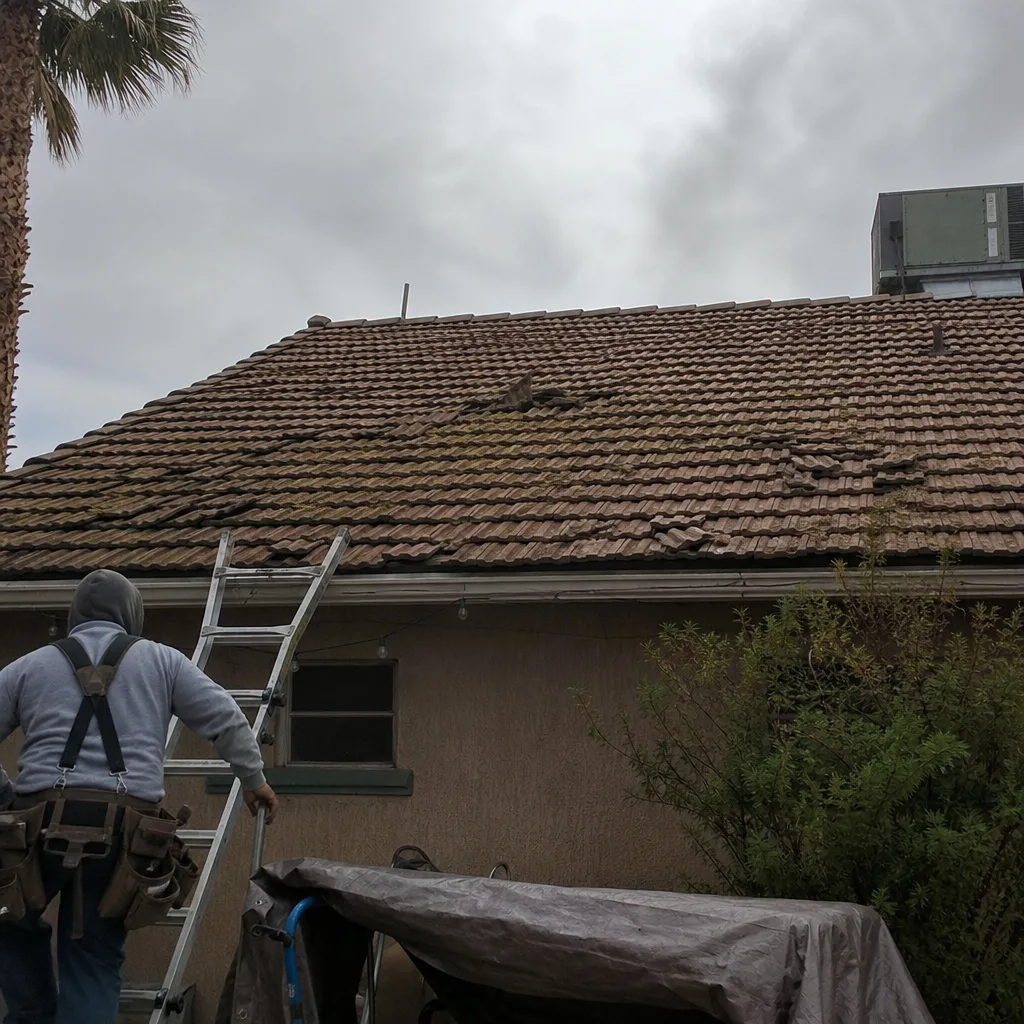 Before
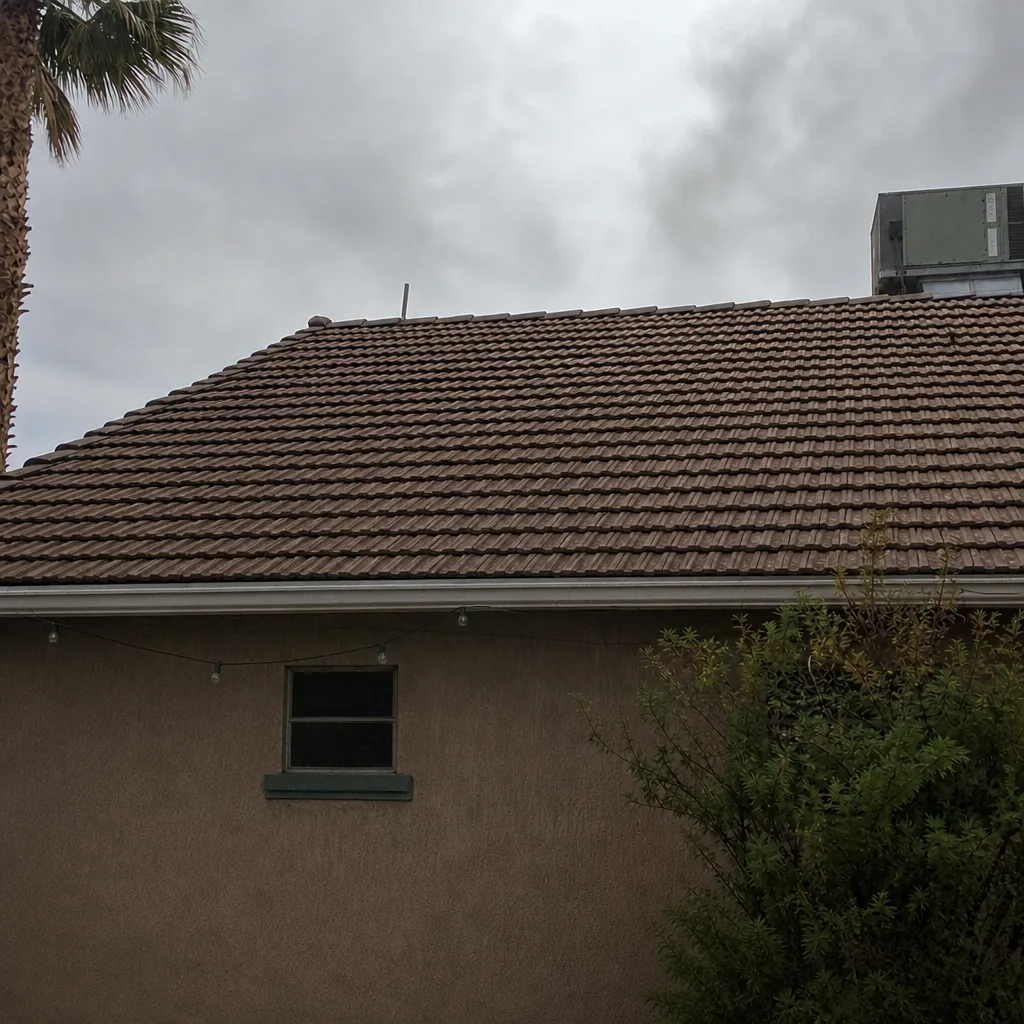 After
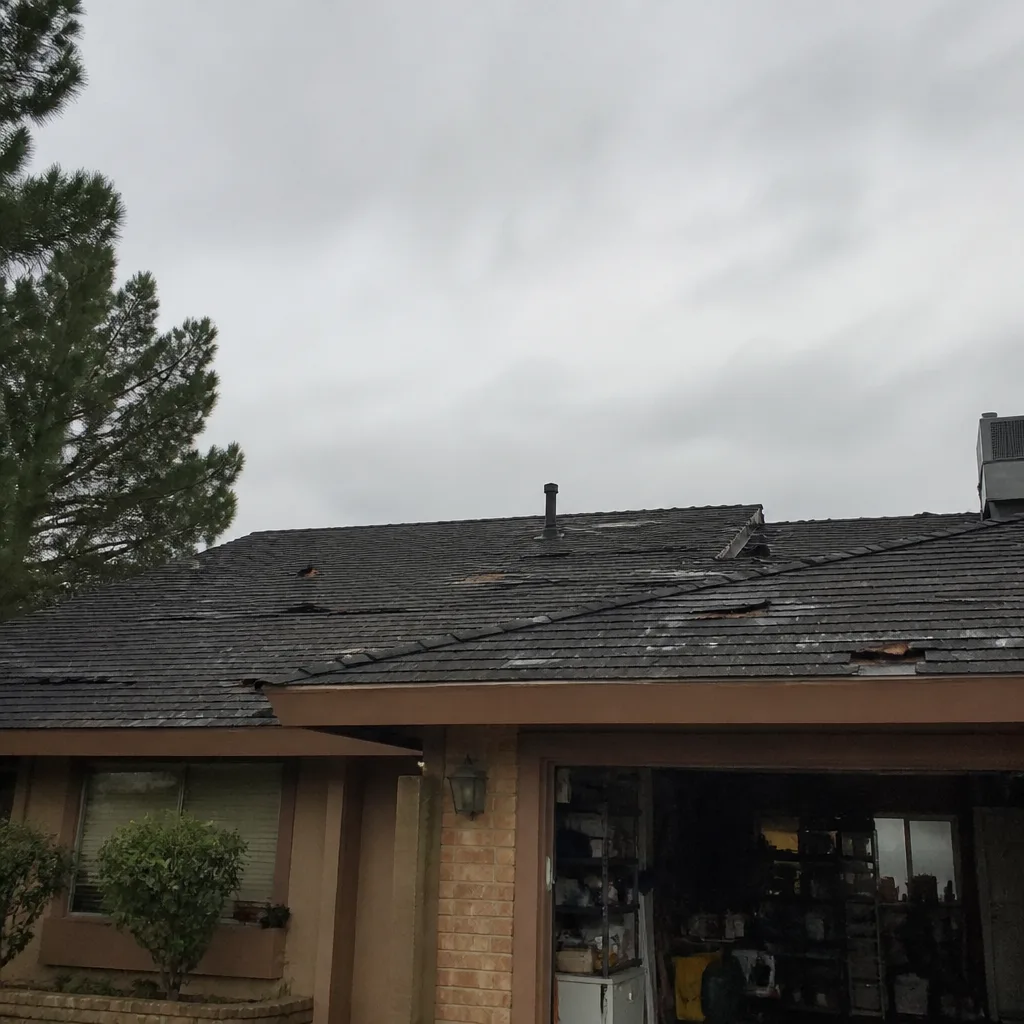 Before
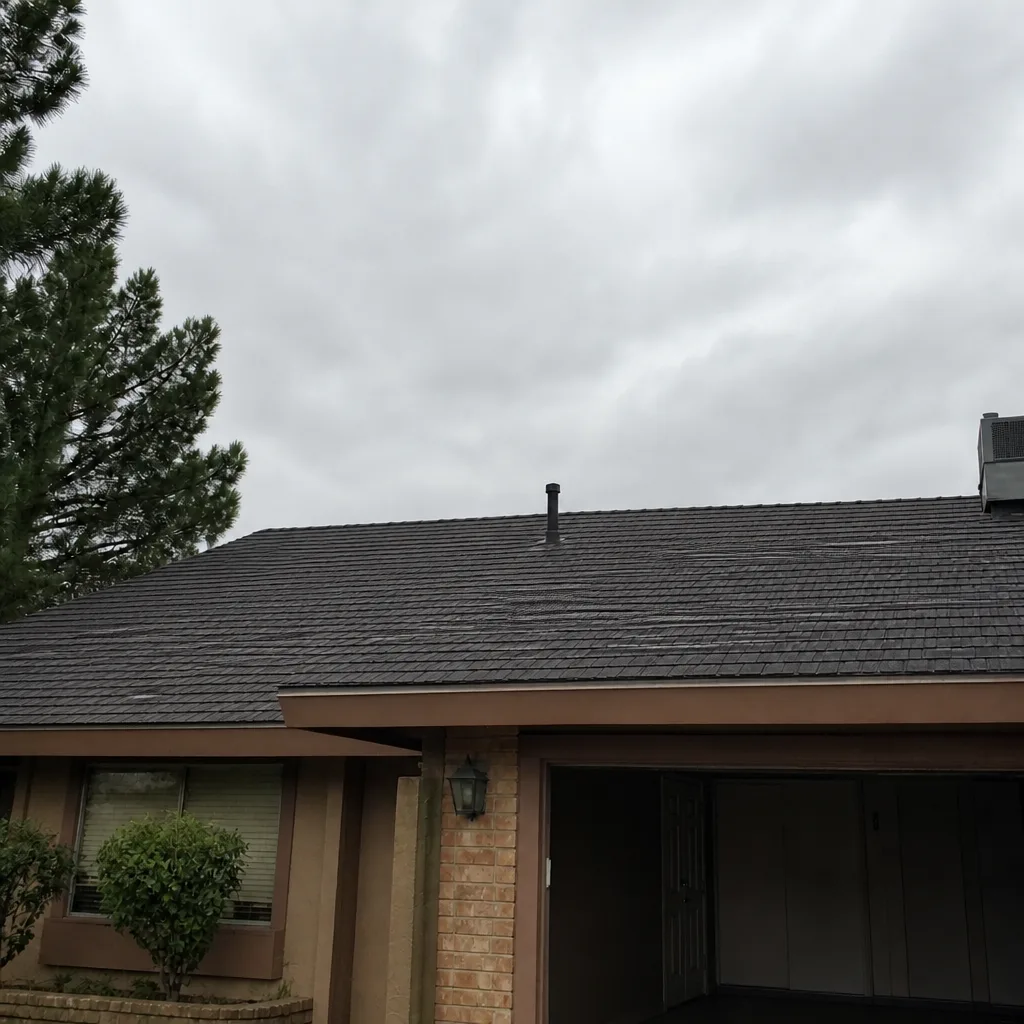 After
Common Mistakes to Avoid
- Climbing on the roof to check the damage. Wet clay tile and loose shingles are a hospital bill waiting to happen, and disturbing a damaged area can void the repair warranty. Photograph from the ground and let a professional go up.
- Calling a contractor before you call your insurer. Open the claim first, then get the inspection. Otherwise the adjuster has no documentation to work from and the contractor’s scope of work becomes the only record.
- Signing a storm-chaser’s contract before the adjuster sees the roof. In Sunrise Manor, this is the most common way a legitimate claim turns into a fight. The signature comes before the damage is even assessed.
- Assuming one clean roof means yours is fine. Microburst damage is block-specific, not neighborhood-specific. Your neighbor’s roof says nothing about your ridge line, your valleys, or your flashing.
- Doing nothing after hail. Hail bruising is the most under-reported damage we see in Sunrise Manor. If hail hit, get it documented even if nothing is leaking yet.
- Paying a deposit to a truck with a P.O. box. A valley contractor can produce a local office and a written workmanship warranty you can hold in your hand. A storm-chaser cannot.
- Skipping the photo documentation on the repair itself. Even a good contractor can leave a minor issue that only shows after the next rain. Photo-documented inspections reduce the chance that issue becomes a dispute.
When to Call a Professional
Some things are homeowner jobs. Storm damage isn’t one of them. Call a professional if you see any of the following after a storm in Sunrise Manor: water coming through a ceiling; visible missing, lifted, or cracked roofing material; a sagging roofline or gutter that wasn’t sagging before; hail bigger than pea-sized that hit your roof; a valley or flashing area that looks disturbed; or an insurance adjuster has scheduled an inspection and you want a documented professional assessment on your side.
We also get called when a homeowner just isn’t sure. That’s fine. A photo-documented inspection tells you whether you have a problem, and if you don’t, you’ll know that instead of worrying. Free second opinions on any written estimate are available. Ridgeline Roofing Co. Sunrise Manor offers free estimates in Sunrise Manor – call (844) 941-3509 and a live person answers, nights, weekends, and in the middle of a storm.
Frequently Asked Questions
Most minor storm repairs in Sunrise Manor – replacing a fewshingles or tiles, resealing flashing, or patching a small leak – typically fall in the low hundreds to around a thousand dollars, depending on the material and how accessible the damaged area is. Larger damage involving multiple roof planes or a whole valley section runs higher. The number on the estimate is the number on the invoice, and estimates are free. Call (844) 941-3509 for an exact quote.
Usually yes, if the damage is from a covered event like wind, hail, or flood. Standard homeowner’s policies typically cover sudden storm damage but not wear and tear or lack of maintenance. Your first step is opening a claim, then getting photo documentation of the damage – which is where a professional inspection helps. Call (844) 941-3509 to schedule an inspection before or after your adjuster visit.
Nevada homeowner’s policies vary, but in practice the damage rarely waits for you. Two things happen fast after a storm: evidence fades, and secondary damage begins. The practical timeline is to open the claim within the first few days, not weeks. Check your specific policy for its exact notice requirements.
Microburst wind rarely strips clay tile, but it cracks it and lifts it slightly, which lets water past to the underlayment below. The tile can look intact from the ground while the underlayment is compromised. That’s why tile roofs need an on-roof inspection after wind, not a curb-check. Call (844) 941-3509 to schedule a photo-documented inspection.
For storm damage in Sunrise Manor, use a local contractor with a written workmanship warranty and a physical presence you can verify. A storm-chaser’s truck leaves the valley after the season, and their verbal guarantee leaves with it. We’ve been at this since 1984, and our 90-Day Done Right Promise is written, in hand, and backed by a local crew.
Yes. A photo-documented inspection is useful even if you’re deciding between repair and replacement, or waiting on an insurance decision. The photos become the record of what the storm did, and you can use them either way. Estimates are free and our phones are answered live around the clock – call (844) 941-3509.
The Bottom Line
Sunrise Manor storms don’t follow the rules of the rest of the country. Microbursts hit one block and skip the next. Monsoons find every gap in your flashing. Hail bruises shingles you can’t see from the driveway. The good news is that a specific, storm-savvy response protects you – document from the ground, open the claim fast, get a photographed roof inspection from a contractor who has worked this valley for decades, and avoid anyone selling you the storm instead of the roof. Done right – and if it’s not, we make it right.
Call (844) 941-3509 for a free estimate. Ridgeline Roofing Co. Sunrise Manor answers live, 24 hours a day.
Written by the team at Ridgeline Roofing Co. Sunrise Manor.